
Uganda has taken a major step toward securing its oil future with a large-scale Uganda oil sector emergency drill at Kabalega Industrial Park in Hoima District. Specifically, the Petroleum Authority of Uganda (PAU) led the exercise today to assess the country’s readiness for disasters like fire outbreaks in the oil and gas sector.
Moreover, the drill brought together licensed oil companies—TotalEnergies EP Uganda, CNOOC Uganda Ltd, EACOP Ltd, and the Uganda National Oil Company (UNOC). In addition, key government agencies participated, including the Ministry of Health, Uganda Police Force, Uganda People’s Defence Force, Civil Aviation Authority, and local governments from the Albertine Graben region.
During the exercise, participants simulated a fire at a base camp that caused multiple casualties. Consequently, the scenario tested how quickly and effectively stakeholders could coordinate a response. Notably, the Uganda Police Force led firefighting efforts, while the Ministry of Health managed medical emergencies.
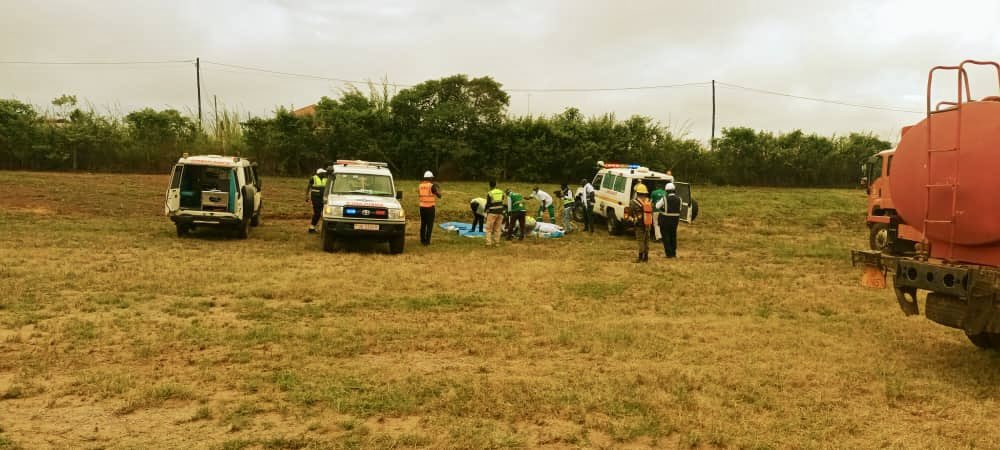
Following the drill, teams held a debriefing session. There, they reviewed what worked well and identified areas for improvement. For instance, Joel Tumwebaze, PAU’s Manager for Health and Safety, represented the Executive Director and shared key findings. He emphasized that the exercise revealed serious gaps in national preparedness.
“In fact, this drill showed that most MDAs lack even basic protective gear,” Tumwebaze said. “Furthermore, the biggest challenge is building capacity.” He warned that today’s scenario involved only a few casualties. “However, in real operations, thousands of workers could be on site. Therefore, district-level response must improve.”
To carry out the training, Glauben Industrial Services Ltd—a health and safety consultancy—designed and ran the simulation. Their goal was to see if government agencies could support oil companies during large-scale emergencies. Although international oil companies have strong emergency plans, they cannot handle every crisis alone.
Justus Tumwesigye, Managing Director of Glauben, stressed the need for stronger public-sector readiness. “After all, oil is a national resource,” he said. “Thus, government must step in when incidents go beyond company capacity.” He also pointed out that frequent leadership changes—like rotating District Police Commanders—hinder long-term training. Additionally, he called for harmonized safety standards across agencies.
At the closing session, Brig. Gen. Fredrick Rugadya of the National Emergency Coordination Centre (NECOC) delivered strong remarks. He urged all stakeholders to treat emergency preparedness as ongoing work. “Indeed, this is a national treasure,” he said. “We simply cannot prepare only occasionally. Because a disaster could be catastrophic.”
Overall, the Uganda oil sector emergency drill marks a critical milestone as the country moves toward first oil production. By testing response systems now, Uganda aims to prevent tragedies later. Consequently, officials agree that regular drills, better equipment, stable leadership, and inter-agency coordination are essential. Only then can the nation protect lives, the environment, and its valuable oil future.
READ: UCI Discharges 50 Cancer-Free Children in September Gold Event


