
Bobi Wine didn’t begin his journey as a politician. Instead, he rose as an Afrobeat sensation whose music struck deep into the heart of Uganda’s youth. Yet over time, his lyrics evolved from club hits to politically charged anthems. In 2018, South African pop legend Yvonne Chaka Chaka called him “my Nelson Mandela in Uganda.” At the time, many found her words exaggerated. However, history is starting to justify that comparison.
By then, Bobi—real name Robert Kyagulanyi—was only a year into his term as Member of Parliament for Kyadondo East. Nevertheless, Chaka Chaka saw something powerful in him. “It’s time for young people to take over,” she declared in Kampala, holding Bobi’s hand. “You are my hero; don’t fail them. All they want is hope for tomorrow.”
Bobi’s real influence came from music. He connected directly with the youth and people from low-income communities, often overlooked by mainstream politics. His songs became rallying cries, filled with hope, anger, and resilience. Inspired by the South African tradition of protest music, Bobi gave a new voice to Uganda’s ghetto youth.
South African artists like Miriam Makeba, Hugh Masekela, and Abdullah Ibrahim used jazz and traditional rhythms to amplify the struggle against apartheid. Similarly, Bobi used Luganda beats and street lingo to challenge inequality and corruption. Just like Vuyisile Mini, who sang a freedom song on his way to the gallows in 1964, Bobi knew the stakes.
In 2017, when a parliamentary seat opened in Kyadondo East, Bobi announced his candidacy. Within weeks, he won by a landslide. But his move wasn’t random. His earlier songs, like Ghetto, had already shown he was politically aware. That track, released in 2007, accused leaders of betraying street hustlers during the Commonwealth Heads of Government Meeting (CHOGM). From that point, people dubbed him the “Ghetto President.”
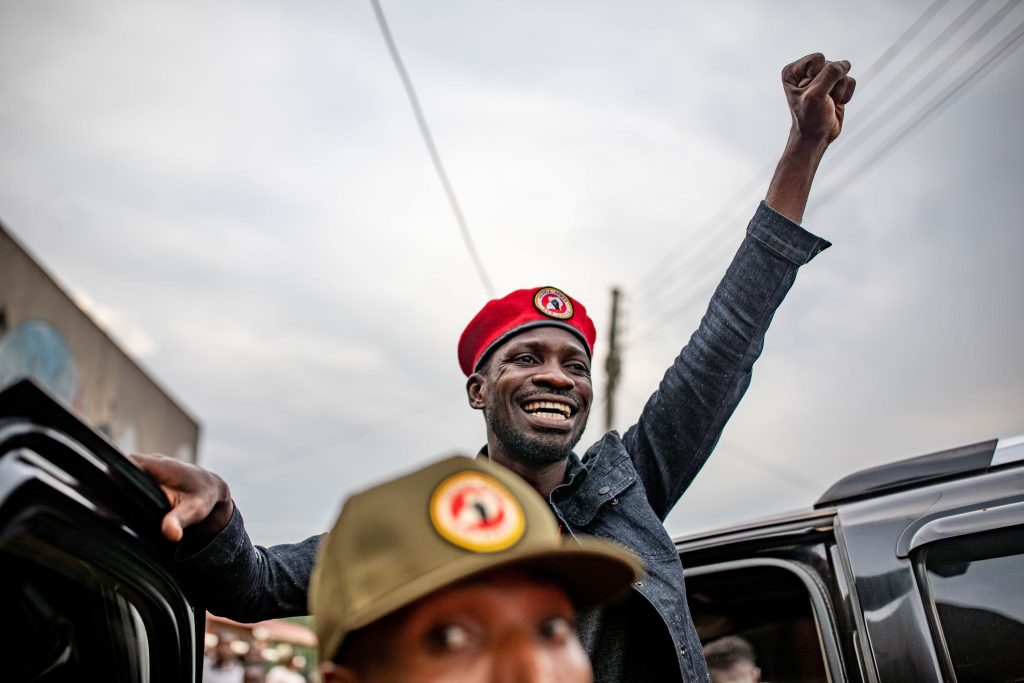
Despite being mocked for his lack of political experience, Bobi proved his doubters wrong. His slogan, “bringing the ghetto to Parliament,” resonated with ordinary Ugandans. As a result, his People Power movement grew rapidly, transforming into the National Unity Platform (NUP). In 2021, NUP became the largest opposition party in Parliament, breaking the monopoly of older political parties.
Initially, the government embraced him. Bobi once performed at state-sponsored concerts, including those promoting peaceful elections. However, that changed after he released Tugambire ku Jennifer, a critique of the KCCA executive director. His defiance intensified with Dembe, in which he asked, “Why don’t you look up to Mandela? He served one term and quit.” Though he claimed this wasn’t aimed at President Museveni, the message was clear.
Soon, the state viewed him as a threat. In 2018, the military blocked over 125 of his concerts. He faced arrests, torture, and surveillance. His driver was shot dead during the Arua by-election. The state accused Bobi of treason for allegedly stoning the president’s convoy.
Despite this, Bobi kept singing. He released Situka, Freedom, and Ogenda, all calling for change. “When leaders become misleaders,” he sang, “opposition becomes our position.” That line became a battle cry during protests after his arrest. International artists like Angelique Kidjo and Peter Gabriel rallied behind him, demanding his release.
This censorship mirrored South Africa’s apartheid-era bans. Songs like Gimme Hope Jo’anna and Ndodemnyama were outlawed for criticizing the regime. But artists found clever ways to protest. Bobi, too, adapted. He created Tuliyambala Engule, blending a Christian hymn with political hope. Artists like Dr Hilderman and Irene Ntale joined him, dreaming of a “New Uganda.”
Still, fear lingered. Promoters faced arrest, and Bobi sued police after multiple concert cancellations. Although court ruled in his favor, enforcement was absent. As of today, Bobi has not performed a major show in Uganda for over six years. His only stages are abroad.
Yet his influence continues. In interviews, Bobi insists he didn’t enter politics to become president. “I came into politics to inspire others to rise up,” he told Newzroom Afrika. His story—from the slums of Kamwokya to global stages—proves that even the most unlikely voices can become national symbols.
Critics argue Bobi is more of a street mobilizer than a political strategist. However, that’s exactly what makes him dangerous to entrenched regimes. As analyst Yusuf Serunkuma noted, Bobi’s real threat isn’t at the ballot box. It’s in his ability to inspire protests. The 2020 riots, which claimed over 50 lives after Bobi’s arrest, demonstrated just how explosive his presence can be.
Bobi’s rise also draws eerie parallels with Miriam Makeba’s. After Sharpeville, Makeba used music to pressure apartheid from exile. Similarly, Bobi urges the international community to stop funding oppression. Yet, unlike Makeba, Bobi returns home freely, engages his party, and mobilizes supporters.
Still, both suffer the same curse—being silenced on their own soil. And like Makeba’s ballads, Bobi’s music is banned not for lack of talent, but because it dares to imagine a different Uganda.
READ: Police Deny Arresting Eddie Mutwe as NUP Headquarters Sealed Off


