
Boko Haram attacks in Nigeria’s Borno and Adamawa states in April 2025 killed at least 22 people. Consequently, these assaults by Boko Haram and its splinter group, Islamic State West Africa Province (ISWAP), targeted rural communities and security forces. For instance, they exposed the ongoing threat in a region battered by 15 years of insurgency. Thus, this article explores these Boko Haram attacks, their context, humanitarian toll, and solutions. Internal link: Nigeria’s Insurgency Crisis
Deadly Boko Haram Attacks: April 2025
Gwoza, Borno: Rural Ambush
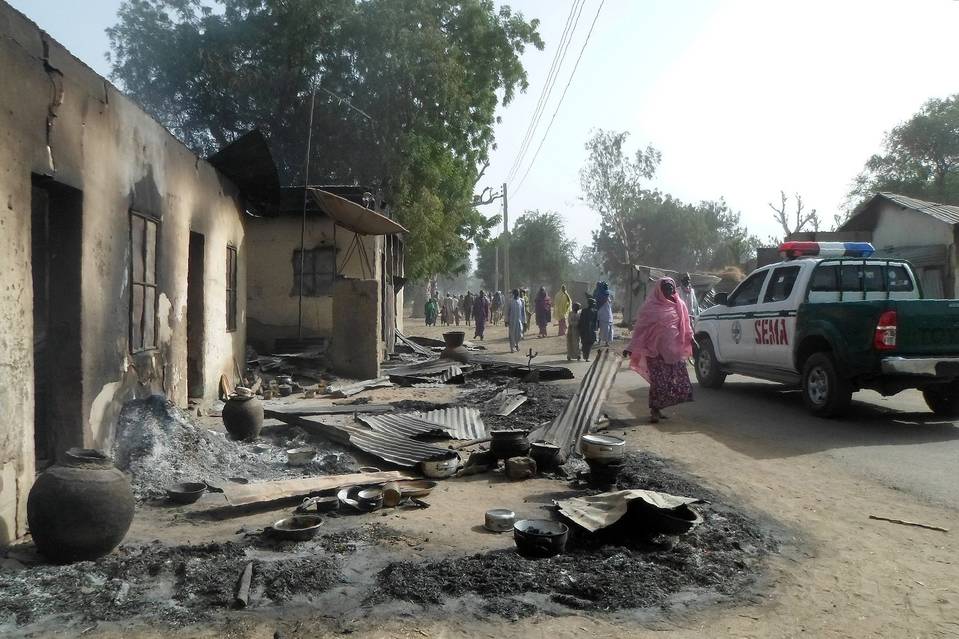
On April 26, 2025, Boko Haram militants ambushed farmers and Civilian Joint Task Force (CJTF) members in Gwoza, Borno. Specifically, the attack killed 14, including 10 farmers and two CJTF members, per Al Jazeera. Moreover, two others were injured. Mohammed Shehu Timta, Gwoza’s emir, confirmed the assault’s impact on farming communities. Therefore, these Boko Haram attacks worsen food insecurity by targeting rural areas with weak security.
Kopre, Adamawa: Striking Defenders
Meanwhile, in Adamawa’s Kopre village, a Boko Haram attack killed 10 hunters and CJTF members. Several others were wounded, according to BBC News. Furthermore, police spokesperson Suleiman Yahaya Nguroje sent more officers to stabilize the area. By targeting Kopre, Boko Haram aims to weaken local resistance. Hence, this shows the difficulty of securing remote regions.
Roots of Boko Haram Attacks: Context
Boko Haram and ISWAP’s Evolution
Since 2009, Boko Haram has sought to create an Islamic state in Nigeria’s northeast. In 2015, it aligned with the Islamic State, forming ISWAP. Notably, ISWAP uses strategic attacks and occasional community aid to gain support. Although the 2021 death of Boko Haram’s leader Abubakar Shekau weakened the group, recent Boko Haram attacks show a revival. For example, corruption and poverty fuel this resurgence. Internal link: Governance Issues in Nigeria
2025 Violence Surge
Indeed, 2025 has seen more jihadist violence. In January, Boko Haram killed 40 farmers in Borno’s Dumba. Similarly, ISWAP claimed an attack that killed 20 soldiers. In March, militants attacked a Wajiroko army base, killing 16 soldiers. Additionally, in April, ISWAP burned homes and a church in Adamawa’s Banga. As a result, Borno’s governor, Babagana Zulum, warned of a jihadist resurgence.
Humanitarian Toll of Boko Haram Attacks
Moreover, Boko Haram attacks have worsened a humanitarian crisis. According to the UN Office for the Coordination of Humanitarian Affairs, 8.3 million people need aid. Specifically, attacks on farmers threaten food security, with 3 million facing hunger in Borno, Adamawa, and Yobe. Furthermore, 57% of Borno’s schools are closed, affecting 3 million children. In 2024, over 580 civilians, mostly women, were kidnapped.
Countering Boko Haram Attacks: Challenges
Military Struggles
Nigeria’s military efforts, like Operation Lake Sanity and the Multinational Joint Task Force (MNJTF), struggle to stop Boko Haram and ISWAP. For instance, rural areas remain vulnerable. Additionally, human rights abuses, such as extrajudicial killings, erode trust, per Reuters. Although the 2025 defense budget rose by 40%, governance reforms are vital.
Regional and Global Issues
Besides, Boko Haram attacks affect Cameroon, Chad, and Niger. However, the MNJTF faces funding issues. The 2021 death of Chadian President Idriss Déby weakened coordination. While the UN, U.S., and UK offer support, the Sahel’s reduced Western presence benefits ISWAP. Thus, the Islamic State’s network strengthens ISWAP’s propaganda.
Ending Boko Haram Attacks: Solutions
To stop Boko Haram attacks, Nigeria needs a comprehensive plan:
- Governance: Fight corruption and invest in education and healthcare. Internal link: Tackling Corruption
- Military: Secure rural areas and boost MNJTF coordination. External link: MNJTF
- Extremism: Use community programs to counter radicalization. Internal link: Countering Extremism
- Humanitarian Aid: Increase aid and protect farmland, per the UN’s Response Plan.
- Accountability: Investigate military abuses to build trust.
Conclusion
In summary, the Boko Haram attacks in April 2025 highlight the violence in Nigeria’s northeast. As Boko Haram and ISWAP exploit weaknesses, Nigeria must blend military action with reforms and aid to end jihadist violence. Ultimately, the future of Nigeria and the Lake Chad region depends on these efforts.
Sources:
Other Nigerian News:


